
Universal Programmable Transmitters: Simplifying Industrial Instrumentation with CALOG 9000/9240
Reducing the number of transmitter types used across industrial applications can simplify maintenance, improve spare parts flexibility and support more consistent instrumentation practices. Instrotech’s CALOG 9000/9240 universal programmable transmitter provides a versatile signal-conditioning platform for temperature and process measurement applications.
Industrial facilities rarely rely on a single sensor technology. Furnaces, ovens, process vessels, manufacturing equipment and general plant monitoring systems often require different temperature sensors and process signals.
As plants expand and equipment is upgraded, the number of transmitter types installed can increase significantly. This creates additional considerations for maintenance, spare parts management, configuration and future system integration.
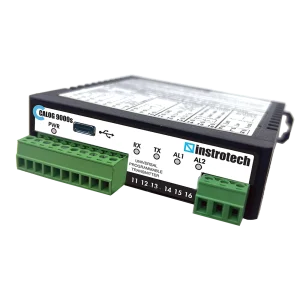
Instrotech’s CALOG 9000/9240 universal programmable transmitter addresses these challenges by supporting multiple measurement inputs through one configurable hardware platform.
“For plants looking to reduce unnecessary instrumentation complexity, the right question is not simply how many transmitters are installed,” explains Pieter Deysel, Managing Director of Instrotech. “It’s how many different transmitter types are genuinely necessary to support the applications in the plant.”
What Is a Universal Programmable Transmitter?
A universal programmable transmitter is a signal-conditioning instrument designed to accept multiple supported sensor or electrical input types and convert them into a standardised output signal. Unlike transmitters designed around a single fixed input type, universal transmitters allow engineers to configure the instrument for different measurement applications within its supported specifications. This flexibility can help industrial facilities reduce the variety of transmitter models required across suitable installations.
CALOG 9000/9240: Multiple Measurement Inputs, One Platform
The CALOG 9000/9240 supports a range of temperature and process measurement inputs.
Temperature measurement inputs
- Thermocouples: J, K, N, R, S, T and W5(C)
- RTDs: Pt100 and Ni100
- Optional RTDs: Pt500 and Pt1000
Additional process measurement inputs
- Millivolt (mV) signals
- Voltage signals
- Current signals
- Potentiometer inputs
- Frequency inputs
The transmitter also supports programmable analogue outputs of 0–20 mA, 4–20 mA and 0–10 V.
By combining these capabilities, the CALOG 9000/9240 can support different measurement and signal-conditioning requirements without automatically requiring a separate transmitter type for each application.
Five Benefits of Standardising Industrial Transmitters
1. Reduce the Number of Transmitter Variants
- Industrial maintenance teams frequently work with instrumentation installed at different stages of a plant’s development.
- Different equipment suppliers, sensor technologies and control requirements can lead to a wide variety of transmitter models.
- Standardising suitable applications around a universal programmable transmitter can reduce the number of hardware variants that personnel need to understand and support.
- This can also simplify configuration procedures and technical documentation.
2. Improve Spare Parts Management
- Maintaining sufficient spare instrumentation is important for plant reliability.
- However, holding separate spares for numerous transmitter types can complicate inventory management.
- A universal transmitter that can be reconfigured for several supported applications may reduce the number of unique spare transmitter models required.
- The actual benefit depends on installed equipment, technical compatibility and the plant’s maintenance strategy.
3. Simplify OEM and Panel Builder Standardisation
- OEMs, panel builders and system integrators often develop equipment variations that share a common design but use different sensors or measurement ranges.
- The CALOG 9000/9240 provides a configurable platform that can be applied across multiple suitable designs.
- Input selection, measurement range and analogue output configuration can be adapted to the requirements of individual applications.
- This supports greater consistency in instrumentation design and configuration practices.
4. Simplify Signal Conditioning and Control System Integration
- Industrial measurement systems often require sensor signals to be converted or scaled before they can be used by compatible PLCs, displays or other monitoring equipment.
- For example, a temperature sensor may operate across a specific measurement range while a control system requires a standard 4–20 mA signal.
- With programmable zero and span settings, the CALOG 9000/9240 allows supported input measurements to be mapped to the required analogue output range.
- This provides flexibility when integrating different sensor technologies with compatible industrial control systems.
5. Adapt to Changing Measurement Requirements
- Industrial facilities continually evolve through equipment upgrades, process modifications and sensor replacements.
- A transmitter originally configured for one measurement application may be suitable for another, provided the new requirements fall within its supported specifications.
- This configurability can reduce the need to replace hardware solely because an input type or measurement range has changed.
CALOG SmartView: Configuring the Universal Transmitter
The CALOG 9000/9240 can be configured using CALOG SmartView, a licence-free Windows software application. Through the transmitter’s USB-C interface, users can configure supported input and output types, measurement scaling and device settings. Using a common configuration environment across multiple supported applications can help engineering and maintenance teams establish more consistent instrument configuration procedures.
Where Can the CALOG 9000/9240 Be Used?
The universal transmitter platform is suited to consideration in various industrial measurement applications, including:
- Furnaces and industrial ovens: Temperature signal conditioning using supported thermocouple types.
- Process vessels and manufacturing equipment: RTD-based temperature measurement and transmission to compatible monitoring or control equipment.
- OEM machinery: Configurable signal conditioning across different machine designs and measurement requirements.
- Control panels and automation systems: Conversion and scaling of supported sensor and process signals to standard analogue outputs.
- General plant instrumentation: Standardisation of compatible temperature and process measurement applications.
Final instrument selection must always be based on the application’s technical requirements.
Universal Transmitters Still Require Correct Engineering
Although a universal programmable transmitter offers flexibility, correct instrument selection remains essential. Before installation, engineers should verify sensor compatibility, measurement range, output requirements, isolation, power supply and operating conditions. A universal platform should be viewed as a means of simplifying compatible instrumentation applications, not as a replacement for sound engineering practices.
Simplify Your Industrial Instrumentation with Instrotech
For industrial plants, OEMs and system integrators looking to reduce instrumentation complexity, the CALOG 9000/9240provides a flexible approach to temperature and process signal conditioning.
By supporting multiple measurement inputs through a single configurable platform, it can help organisations improve standardisation, simplify spare parts planning, and adapt to changing application requirements.