
Instrotech has announced the launch of the new CAL9000 and 9240 programmable temperature transmitters, designed to convert thermocouple and RTD sensor signals into standard industrial outputs for reliable temperature measurement and process control.
Both models support a wide range of sensor types, feature three-way galvanic isolation and offer convenient configuration via a standard USB-C connection. The CAL9000 is powered by 220 V AC, while the CAL9240 operates from a 24 V DC supply, providing flexibility to suit different installation and power supply requirements.
3-way galvanic isolation and standard 4–20 mA or 0–10 V outputs simplify specification and spares across mixed-sensor plants
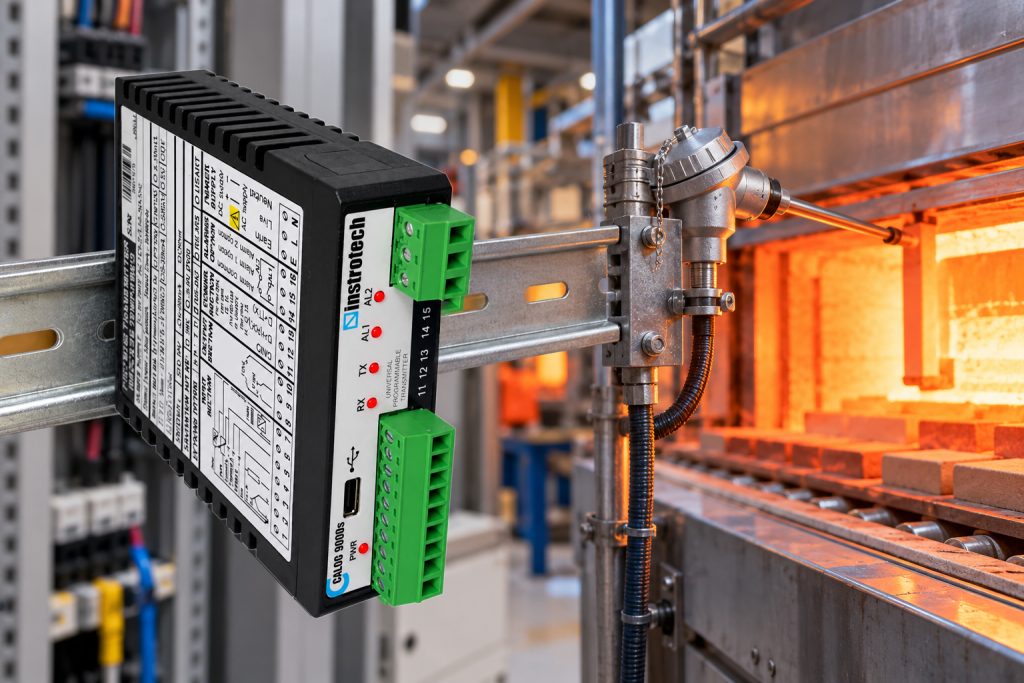
For plants that use multiple temperature-sensor types, a single flexible platform can simplify specification, replacement and standardisation, helping to streamline instrumentation management and maintenance.
Designed to adapt to the application, rather than forcing the application to conform to the transmitter, the CAL9000 and 9240combine versatile sensor compatibility, electrical isolation and straightforward configuration in a practical solution for industrial temperature measurement and process control.
Making sensor measurements usable
Temperature measurement may look simple on a process diagram, but several electrical and engineering steps lie between the sensor and the displayed value. A thermocouple generates a small voltage related to the temperature difference at its junction, while an RTD changes resistance with temperature. The control system needs an interface that can interpret the sensor readings correctly, linearise the measurements where required, and provide an output that the receiving equipment can use.
The CAL9000 and 9240 converts the sensor’s native electrical behaviour into a standard 4–20 mA or 0–10 V signal. PLC, SCADA and display systems can then be designed around predictable input ranges, even when the field sensors differ.
“A temperature transmitter is more than a device that converts one electrical signal into another. It serves as the critical interface between the temperature sensor and the wider control system, transforming the sensor’s measurement into a standardised, reliable signal.” said Hugh du Plessis, R&D Director at Instrotech. “The CALOG 9000/9240 has been designed to adapt to the application, offering configurable functionality and flexibility to meet specific measurement requirements, rather than requiring the application to conform to the limitations of the transmitter.”
Broad sensor support
The transmitter supports thermocouple types J, K, N, R, S, T, and W5(C), as well as Pt100 and Ni100 RTDs, with Pt500 and Pt1000 available as options. It can be configured for °C, °F or Kelvin.
Isolation for demanding panels
Industrial panels may contain power supplies, drives, contactors and multiple instrument circuits. The CALOG 9000/9240provides 3-way galvanic isolation (1000 V) between input, output and power circuits.
Scaling matched to the process
Programmable zero and span settings allow a defined process range to be mapped to the analogue output. The receiving system then sees only the range meaningful for the application, rather than the sensor’s full measurement capability.
Configuration with a standard USB-C cable
An onboard USB-C interface and SmartView software are used to configure input and output type, scaling and device behaviour. Maintenance and commissioning teams can perform local setup using a standard USB-C connection instead of a dedicated proprietary programming lead.
Applications for the CALOG 9000/9240
The CALOG 9000/9240 is suited to industrial temperature measurement and process monitoring applications where supported thermocouple or RTD signals must be converted into standard analogue outputs.
Potential applications include:
- Industrial furnaces and ovens: Temperature monitoring and integration with process control equipment.
- Process vessels and tanks: Converting installed temperature sensor signals for control and display systems.
- Manufacturing and production equipment: Standardising temperature signals across machinery using different sensor types.
- Industrial control panels: Integrating thermocouple and RTD measurements with PLC and SCADA systems.
- Plant maintenance and instrumentation upgrades: Replacing application-specific transmitters with a configurable alternative where specifications are compatible.
Simplifying Temperature Instrumentation Across Industrial Plants
As industrial facilities expand and equipment is upgraded, maintaining numerous temperature transmitter variants can increase the complexity of instrument selection, spare parts management and maintenance.
The CALOG 9000/9240 offers a flexible approach by combining broad sensor compatibility, programmable output scaling, galvanic isolation and USB-C configuration in a single transmitter family.
For engineers, OEMs and maintenance teams, this can simplify the selection and configuration of temperature instrumentation while supporting consistent integration with industrial control systems